
Healthcare: Talking Points & Numbers
June 24th, 2009I’m going to be throwing a lot of numbers around over the next few posts. I intend to source them with US government numbers or as independent, non-partisan sources as I have found.
First, why is healthcare so expensive in the U.S.? Most of my information will be coming from a 2007 McKinsey report on Healthcare costs in the US. To download the PDFs from McKinsey, registration is required. There are two PDFs; a synthesis report that is fairly brief and a longer, more detailed report. Both are worth viewing and downloading.
Main points of this reporting worth considering (these are taken from the shorter PDF linked on the McKinsey page as “Synthesis”):
- The United States spends more of its wealth on health care than any other developed country.
- The amount is 16% of GDP. This expenditure on health care is more than the U.S. spends on food. This bears repeating. The United States spends more on health care than it does on food.
- The U.S. spends $1,645 MORE per person than 13 other Organisation for Economic Co-operation and Development (OECD) countries. (more here, you’ll have to click into “Health” as the site is done using frames and linking to the specific page is difficult)
- The U.S. health care system is intrinsically more expensive in the following areas: hospital care, drugs, outpatient care, administration, insurance and public investment in health.
- The U.S. consumes LESS drugs than Canada, Germany and the UK.
- U.S. drug costs are 50-70% higher than peer countries.
- U.S. physician compensation is 6.6 times GDP per capita for specialists and 4.2 times GDP per capita for generalists compared to 4 times GDP per capita for specialists and 3.2 times GDP per capita for generalists in peer countries.
- U.S. physicians see, on average 1.6 times more patients than their counterparts in peer countries.
- In 2003, the U.S. spent $412 per capita on health care administrative costs—nearly six times that of other OECD countries.
The U.S. is expensive. These are just top-level points. The complete McKinsey report is well worth reading as all of these points are examined in a depth that I cannot do here. I did not touch physician owned facilities where expensive procedures (scans, outpatient care, et al) are performed. I also have not talked about expensive technology and how it is utilized and/or self-referred from physicians who also have a stake in said facility.
Many people are calling into question the number of uninsured in the United States. This chart:
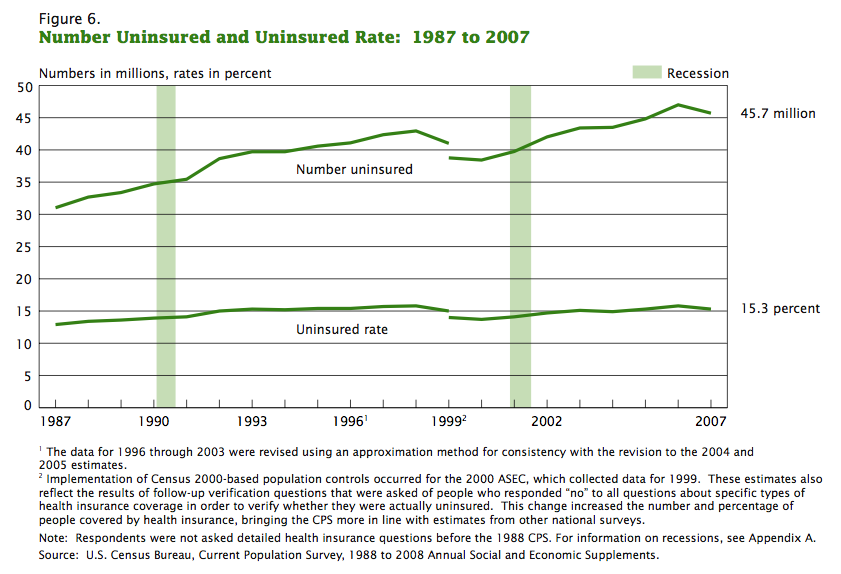
from: U.S. Census information about uninsured as of 2007. It’s a PDF.
Whether or not you count illegal immigrants in those numbers or not, the number of uninsured in the United States is far too high and is a travesty. It is nothing short of a massive market failure to provide a service to the general populace. It’s a damning blow to privatization of for-profit healthcare.
Finally, the U.S. spends a great deal of money on health care, surely this would mean the U.S. has a better quality of health care service, care and delivery. However, the U.S. ranks lowest on overall life expectancy compared to England, Germany, France, Italy, Holland, Denmark, Sweden and Japan.
See also: WHO rankings and Study on Healthcare Quality.
Your thoughts? o
Tags: healthcare, u.s. healthcare

As I hear detractors’ points, specifically that a govt. backed option would run healthcare companies out of business, I ponder this:
FedEx and UPS seem to be doing just fine alongside the US Postal Service. Each option caters to different customers but pretty much offer the same services.
I don’t think the argument of detrimental competition is valid.
As for the numbers crunching, it never adds up for me, though I’m admittedly horrible at math. I do think though, that unless you’re in construction or food service, one’s job is likely to be shipped overseas – largely because of healthcare costs. I’m (not) surprised more detractors aren’t addressing this competitive disparity in the global workforce.
I don’t know what the answer is…..I just know there is a problem.
We were your average 20 something college graduates starting out in the world. I married my husband, we bought a house, and lived life to the fullest…..not using our insurance because we were young and healthy. Then I got prgnant and went to the doctor more in 7 months than I did in the previous 7 years.
Our daughter was born 8 weeks prematurely and spent 30 days in the NICU. Needing to spend time in the “tanning bed” was the least of her worries. My insurance company (thank God we actually had insurance) is still auditing her final hospital bill, but the toal so far is $189,642.56….plus she has physician bills on top of that. That is just her bills…..I have my own bills as I needed hospital bedrest and an emergency c-section.
I could write a book about our recent healthcare experiences, but that’s not really what you are asking for. I do however have one perfect example that backs up your report. I’ve personally weeded through hundreds of pages of line by line charges from both of our hospital stays. There’s quite a few interesting tidbits, but this is my favorite…….ONE 100mg ibprophen cost $12.30 whereas ONE Percoset cost $8.60. I’m not sure about your Costco in Utah, but I think I could buy an entire bulk jar of Advil for $12.30. And that says nothing about the Percoset. How in the world could an Advil cost more than a Percoset?
Mind boggeling I tell you….
The most shocking stat from all of that is the one about us spending more on health care than food. Also, how we compare to other countries. I think that illustrates a clear problem. It’s the most obvious point and probably the one most easily tackled by the current government.
I’ll play devil’s advocate a bit though on two points that often come up in the defense of our current system.
1) It’s easy to quantify our numbers but not easy to measure quality. How do we rank in quality? This defense is often enacted by comparing us Canada and Sweden, who have “free” healthcare but lower quality (I have personal experiences in both countries).
2) The cost of our drugs is high, but I’m also under the impression that we develop most of the world’s modern science in drugs and therefore pay for that development greatly in the first 5 years of FDA approval (until they’re allowed to go generic).
I’ll be linking and discussing qualitative measurements and perceptions in a subsequent post. The numbers are out there. The U.S. does not rank well.
Your second point is a good one. We’ll also be looking at drugs/pharmaceuticals in a subsequent post.
An example of the excess testing that drives up our costs:
http://www.flickr.com/photos/brooklyn_museum/3654365784/
Research is obviously stupid. You are soooo right. /sarcasm.
Is this all you are going to contribute to the conversation?
I’m all for research, but I think that chap is beyond even the most audacious hopes.
It takes me forever to write a serious comment. I make ‘em when I can. Sometimes I’ve got other contributions.
I don’t think the link between money spent on healthcare and life expectancy is necessarily a good indicator. true, good medical care can prevent many diseases, but seeing as heart disease and cancer are two of the leading killers, medicine is often not able to cure these ailments. if you have a population that does not lead a lifestyle that is conducive to stopping these issues, the best doctors and all the money in the world will not help.
I have a couple of questions/comments:
1. Canada, and some other countries I believe, regulate the cost of drugs. Is that correct? I know I’ve read that, but I couldn’t find a source at the moment.
2. What percent of the cost of US medical care is malpractice insurance?
3. As I said on Twitter, I think our lower life expectancy has much more to do with our lifestyles than our medical care. That’s a hunch, and not based on any statistics (not that I’ve looked for any), but as I look around at the girth of my fellow Americans, I think I’m right.
Re: your second question:
Page 18 of the full report from the searchable McKinsey report:
Doctors pay on average, $27,500 per year in malpractice insurance premiums. 700,000 doctors means around $20 billion is spent on malpractice insurance. Of the complete medical expenditures at $1.2 trillion, thats less than 2%. However, other countries physicians do not have to pay malpractice premiums. So that $20 billion is added to the expensive healthcare in the U.S. It also contributes to the practice of defensive medicine where physicians order needless tests and procedures just to cover themselves.
Re: 3. If you’ve read the report (which it’s clear you haven’t, so consider this a scolding) you would know that the U.S. has higher diabetes rates; 6.7% compared to 4% in peer countries and higher blood pressure; 18.3% versus 13.9%. The U.S. populace is more sedentary and more likely to be obese. This point is made repeatedly in the McKinsey report: these areas are prime targets for prevention education and awareness. If we did a similar marketing and education with diabetes that we’ve done with tobacco, I think we’d see rates drop. I also think that if we worried less about working overtime and worried more about walking, hiking, biking and being active, we’d see drops as well.
You are correct, I haven’t read the report yet. I saw this post from work, and didn’t have time to download and read the report. I will though.
Regarding point 3 – are you agreeing with me that mortality rates have more to do with lifestyle than quality of healthcare? I absolutely agree with you that making adjustments to the kind and quality of food we eat, coupled with an increase in activity would go a long way towards increasing mortality rates in the US. It would also decrease overall the cost of healthcare. We spend too much time treating illness and not enough time preventing it.
Regarding point 2 – what is your thought on tort reform? Having been with my wife through three pregnancies, I can certainly attest to the overly cautious nature of hospitals. They take great lengths to avoid getting sued.
The U.S. has a high diabetes rate because our diet is crap. Everything we eat is laced with chemicals, GMO’s, MSG, high fructose corn syrup, etc. Our food supply is poisonous and you won’t hear that on CNN. How can we expect the American people to stop eating the crap food/crack when it is laced with addicting MSG that makes you crave more? It’s a vicious cycle. They do not make it easy or cheap to eat healthy, but they make it so easy to eat crap food because it is easier to make cheap mass produced processed foods with chemicals that extend the shelf life and it is more profitable to keep people fat and sick…the healthcare industry is getting rich off the fat and sick people.
Please take a minute to check out some of the following information:
This is a trailer for a documentary about six fast food eating Americans that eat 100% vegan live foods for a month. Medical results are fantastic. By the end of the 30 days they have all cured their type-2 diabetes. WOW…imagine that. http://www.youtube.com/watch?v=jSuqCMld00w&NR=1
Or read about The Truth about Aspartame, MSG, and Excitotoxins here: http://gavintiegirl.files.wordpress.com/2009/05/aspartame_truth.pdf
You want to be really angry at big business watch this. What company has the right to hold the patent on our food supply? All about GMO’s with The World According to Monsanto:
http://www.youtube.com/watch?v=c_OJcPKEYDE
There is a lot of educating to do and most people don’t want to listen. Every since I saw the movie The Beautiful Truth: http://thebeautifultruthmovie.com/ I have been awakened and spiraling down the rabbit hole of awareness. I have been sharing this information with everyone I know and even people I don’t know. Some people are open-minded and others don’t want to be told that soy is bad for them because they drink soy milk. And others don’t want to know that there is MSG or hidden MSG in everything they eat and that they will need to read labels better to find chemical free food. They don’t want to know that they have to give up their favorites foods because if they don’t they are poisoning themselves.
Read the truth about MSG and hidden MSG (other names for it) here: http://www.msgtruth.org/
As long as the food supply is poisoned with all these chemicals and genetically modified foods we will continue to be a country of sick people who require more assistance with our health and more drugs than any other country. Other countries have banned MSG and GMO’s. Makes sense that they have better healthcare statistics. I am not going to change the world by sharing this and most of the people that read this blog probably already know about most of this, but if not, please check out some of the links I have provided and make yourself aware and then share this information with others. Our health and the health of our children are really in our own hands and minds. We can’t trust our corporations, the FDA, the AMA, or the government with our health.
Don’t forget the conservative argument for it. The biggest drag to starting a new business in the United States is health care benefits. When you’re trying to get on your feet and startup a company it’s nearly impossible to attract high quality people because small startups can’t afford the health benefits that large companies can. Almost all technology startups require large amounts of venture capital. They don’t require it for computers or office space. They require it to pay salaries and health benefits.
Take health benefits out of the equation and suddenly it becomes much easier to start that business in the garage. This is all removing hindrances to American ingenuity. It’s a great way to get the economy roaring again (and for a productive reason).
People keep bringing up the postal service as an example of awful government programs since Senator Boehner brought it up in that press conference recently. I’d just like to point out two things on that.
1. The postal service is an astoundingly efficient and productive organization. If we could get a healthcare option for the U.S. that was half as useful, we’d be doing pretty damned well. If anything, it’s a stellar example of how government on occasion does get it right. I invite everyone to take a look at the Postal Service’s history at their site:
http://www.usps.com/cpim/ftp/pubs/pub100/welcome.htm?from=SignificantDates&page=RightBanner_Pub100html
All of their financials are also readily available for those who enjoy balance sheets.
2. The postal office became a separate independent entity in 1971 when it became the Untied States Postal Service. It’s kind of a stretch to call it a government organization anymore. Though they still do answer ultimately to congress and the President.
So can we stop looking at the USPS as a bad thing now? If anything we need to look at it more closely.
Um, maybe you’re referring to something else, but no one here has put up the USPS as an example of “awful government programs.” In fact, glass’s comment said, “FedEx and UPS seem to be doing just fine alongside the US Postal Service. Each option caters to different customers but pretty much offer the same services.” I think the point glass was trying to make that government programs can co-exist with private corporations having the same aims. In this case, the analogy leads us to a mixed private-socialized medical system.
Reading is fun!
I know. Glass had no negative things to say. It’s just that it’s one of those points that bubbles up in these conversations since Boehner brought it up. It needs to be laid to rest is all.
Please explain why this awesomely productive organization requires a monopoly on delivery of first class mail.
Now, I like the USPS. I think universal delivery is the right concept. Delivering mail to communities that can only reached by mules for $0.44 a letter knits the country together. Fine, good. But a great deal of what they do could be done faster, more reliably, for less.
All great points. I came across a live web chat today on the Brookings website about health care and health care reform: http://www.brookings.edu/events/live-chat.aspx. It’s going on now, so maybe we can get some questions answered!
Here I come again with my EMTALA argument. When was it enacted? 1986.
Watch what happened:
http://www.ncbi.nlm.nih.gov/sites/entrez?Db=pubmed&Cmd=ShowDetailView&TermToSearch=7475402&ordinalpos=62&itool=EntrezSystem2.PEntrez.Pubmed.Pubmed_ResultsPanel.Pubmed_RVDocSum
(may have to register for this)
Now, I see that the study focuses on the HMO influence; however, I can’t help but think there is a little cause and effect going on there, but it may simply be a case of correlation. Statistics suck.
BTW, Jon:
I really, really appreciate you opening up this dialogue. I too am wanting something better for myself and my kids. Healthcare is one of them. We spend an inordinate amount in premiums every month and it is SICKENING.
I promise to keep an open mind, if you will as well. We can swap stats and honestly discuss the shit-hole that is this healthcare “system” in the US. It’s time for everyone to put their respective D or R to the side and start forming a solution. So, again, thank you.
I promise to stay off my grass.
I will read I promise, but here’s where I start from.
1. The idea that healthcare is an employment related issue is part of the problem If employers want to offer healthcare coverage as a way to attract employee, great. The days of pensions and the benefits are over.
2. As a household of two self employed people with two teenage boys, healthcare costs us about $1300 a month. Luckily, we are able to get “group” insurance through the OSCPA.
3. If we are unable to pay our premium and are dropped, or wanted to shop around for care, not one insurance company would accept us for an individual policy and we are relatively healthy except for an issue I have with my hip that will require a hip replacement probably in about 10 years or longer. Insurance companies have a bias towards turning down people whenever they can.
4. I would like those politicians who are against a public option to gather those they represent in one place and ask them if they would be for a public option. I think they’d be surprised how many of their constituents have no problem with it.
Hey Jon… Thought I would delurk to kind of comment on this and your other topics.
I am Canadian so our healthcare is vastly different as some of your posters have noted. It is not some awful thing with huge lines and no one gets any help that I have seen some people make it out to be. What we have to pay for in BC is our MSP (Medical Services Plan), most provinces pay for it so the individual doesn’t have to. Here it is 54$ each, 96$ for a family of 2 or 108$ for 3 or more. If you are lucky your work benefits covers yours, mine does but for awhile we were billed and they want 6 months in advance at a time.
That covers our dr’s appointments, ER visits etc. Pharmacare covers our prescriptions and you just need to be enrolled (I don’t know all the details about that one).
For the wait times, it depends. We are slowly running out of family dr’s here so many people go to the ER with runny noses, coughs, etc. Things they should go to their dr or a local walk in clinic for. Major things get you in quick, trauma patients, heart attacks etc. My husband came in with a broken leg 2 years ago and we were in a bed in the ER for 4 hours before he had a bed on the ortho ward.
His surgery (while not elective) was on the emergency board so if anything else major came along he was bumped down. He was admitted Thursday night and had his surgery late Saturday night.
Things like that get treated, unfortunately something considered elective will have a larger wait list and I have heard that sometimes hip replacements fall under that category. Something that hopefully will get fixed, but our government is a mess and has been for a while.
We have started some private options, pay for your care and we do have a few private pay for the whole thing clinics in Vancouver but you are looking at thousands of dollars a year to just be enrolled. Something that majority of our province can’t afford or want.
I am sorry I am bit off topic for your post today but I did find this article online that you maybe interested in. Especially the paragraph about Insurance dictating where some patients have to have their transplants.
http://www.cnn.com/2009/HEALTH/06/24/liver.transplant.priority.lists/index.html
Thanks for opening this up Jon and congrats again on Baby Marlo!
Kristina my blood pressure rises just thinking about having to deal with those bills. Again I’m thanking my lucky stars that I’m living in a country w/ socialized medicine. I’ll just tell you about the conversation I had w/ my mother when I went in to see the midwife for a pre- induction exam. I was 5 days over due and my Mom was over from the US for the birth. and she was leaving in 4 days. While waiting for the midwife my mother was looking around and mentioned how old everything looked. I just looked at her and said it might not be the newest and most shiniest equipment but they were all clean and all worked. MOST importantly I wouldn’t be saddled with a bill no matter what the complications might be. Next time you’re at the clinic/docs office/ER/Hospital look around and you’ll see where that $12.30 advil went- someone has to pay for the latest state of the art equipment and the merc parked out front.
The first comment is fundamental to the issue- the healthcare BUSINESS
I have flamboyantly not done the reading. No time, and I’m prepared to stipulate our system costs too much for results delivered.
So what?
What are we trying to do here? Lower costs? Or make sure everyone gets care? Or use health insurance as a redistribution mechanism?
The first and most important cost problem is the detachment of consumers from their costs through employer insurance. Since each increment is basically free, people consume more than they really need — excess tests, marginal procedures, etc. And neither they nor their doctors scrutinize the stuff they really need for efficiency of provision. Beginng to solve this is conceptually really easy: start taxing employer provided health benefits.
I don’t think anyone really objects to universal coverage, but the problem starts when you use that as a cover for another agenda. We can get there by rationalizing the cost problem (see above), insisting people get their own insurance, seeing who can’t afford it and subsidizing them. Done, but some people will be larger amounts of their income for health care, and the transparency of the subsidies is politically awkward.
Many will interpret that as a regressive outcome, and will want more subsidies than the electorate likes. So that path will be criticized as costing too much, and proposals to cover everyone through the government. The subsidies for this will be funded by progressive taxation, and less affluent people will have more income after health care. But now we’re back to the care/cost detachment problem, and we’ve got an insensitive bureacracy running things, and the eventual decisions about what care to not provide will be made politically.
This really isn’t a debate about universal coverage. It’s a debate about structuring a marketplace in a manner that gives government power to direct distributions, in the expectation that power will be used to achieve a variety of worthy goals. We’re all better off if we let the markets figure out the prices, and leave the redistributions to the political debate.
Jon,
At this point I just want to make a comment on the malpractice issue. If we are going to truly get some improvement here we need to set limits. And not limits on the amount a wronged patient can sue for, but the percentage of the settlement or award that the attorneys receive. The biggest reason for the astronomical cost of malpractice insurance, high awards and (good call) “needless tests to cover themselves” are greedy lawyers. Let’s make that part of this discussion. Let’s set limits–not on awards to those that were wronged–but on attorney fees.
I love that you are dealing with this issue. I am lucky enough to be married to a woman who works for a non-profit HMO and I am thrilled with my coverage and my care. But her job is in underwriting and when I hear about the kinds of costs that she has to take into consideration when deciding where the new rates are. More later.
Here’s my two cents – I was sickened when I watched Sicko (har de har har) by Michael Moore – not that he is the most reputable reporter of the modern times, but still. The fact that 9/11 rescue workers, one who suffered from PTSD and had ruined his teeth with his nighttime teeth-grinding habit – were taken to CUBA and given free health care. CUBA!! The guy went to CUBA and came back with an entirely new set of teeth for FREE! It’s hard for me to stomach the fact that a communist country that we aren’t even allowed to travel to can offer better health care, for free, to their citizens.
I happen to be a single mom of a three and a half year old girl and I make around $25,000 a year. This sad little fact qualifies me for state/government assistance with insurance, and all of my medical expenses are paid for by other’s tax dollars. People hoot and holler at me a lot for this, but let me tell you – I would be in the dog house if I didn’t have that. My daughter has hip dysplasia, so she has already been through two surgeries, and we have been going for x-rays, or CT scans every three to six months since she was born. Not to mention the physical therapy appointments, and the regular doctor’s visits. Without even considering my own health care costs, I imagine that I would currently be somewhere around $200,000 in debt or more. And of course, I am employed by a small business that offers health insurance I would only be able to afford if I chose not to buy groceries instead.
So yeah, my health care is technically free, but is it quality care? Sort of. There are only a handful of primary care physicians that take my insurance, my STATE insurance, within an hour’s driving distance from my home. That means that every time I go see my doctor I wait in the packed waiting room on average about 1.5 – 2 hours and then see a doctor for about five minutes. These doctors aren’t interested in talking to me about my diet, exercise, mental health, etc. They pretty much treat my symptoms and send me on my way. I actually get better care from doctors if I go to the ER instead, though I feel at ER’s there is a stigma against me, and generally a sort of prejudice that borders on, like, racism for people with my insurance. We’re the “poor ones,” the “leeches on society.” I get the impression that people think that because I am on state insurance that means that I have a crappy job, if any job at all, that I live in a slum, and probably don’t take very good care of my kid. In general, I feel looked down upon, and I feel that I do not receive the level of good care that patients do who actually pay cash for care or are with private insurance companies.
Now, I am not writing all this so you can hear my complaints and sob story. Quite the contrary. The fact is I can’t complain – whether I’m treated well or not, at least I am treated, at least I don’t have to be afraid of getting sick or afraid of the bills that will come in the mail after my daughter’s four annual CT scans. I guess I commented here to say that as a person who has insurance currently funded by the government that I personally think, in theory, that government run health care isn’t such a bad idea. There is no way I would have the good quality of life I do if I had hundreds of thousands of dollars to owe insurance companies or hospitals – the stress alone of those bills would break my spirit and any faith I have in this country and how it cares for its citizens.
I am not sure what the numbers are for people who are on state/government insurance programs, but seeing that there are nearly 50 million Americans with no coverage whatsoever, I think it is time for the world to see – for our government and all citizens to see – that there are so many of us who struggle every day just to be able to pay rent, pay for day care, to pay for groceries, gas, clothing, you name it – before paying for insurance in case we get sick or get in accidents we can’t prevent, not to mention preventative care. The way things are now, citizens are pretty much being told that health care is not a right, it’s a privilege that is granted to those who can afford it.
So yeah, I think it’s definitely about time that the government steps in and does something for ALL Americans. We’re kind of in sad state of affairs at this point, huh?
Interesting to see the actual numbers on how much doctors make in the US vs other countries. There’s a real doctor shortage here in Canada at the moment, because all of our doctors are defecting to the states where all the money is. Most of the people I know (in their mid-20’s to early 30’s) don’t have a GP… Instead, whenever they need to go to the doctor they end up going to walk-in clinics. Far too many GPs in Canada (I want to say most, but I don’t have any numbers to back this up) are completely full, not accepting any new patients. Most of my male friends are skipping out on their annual physicals because it’s too much hassle to go to a walk-in clinic for one.